
Romanian Green PPA 2026: Six Takeaways on PPA Structures, Battery Storage and Guarantees of Origin
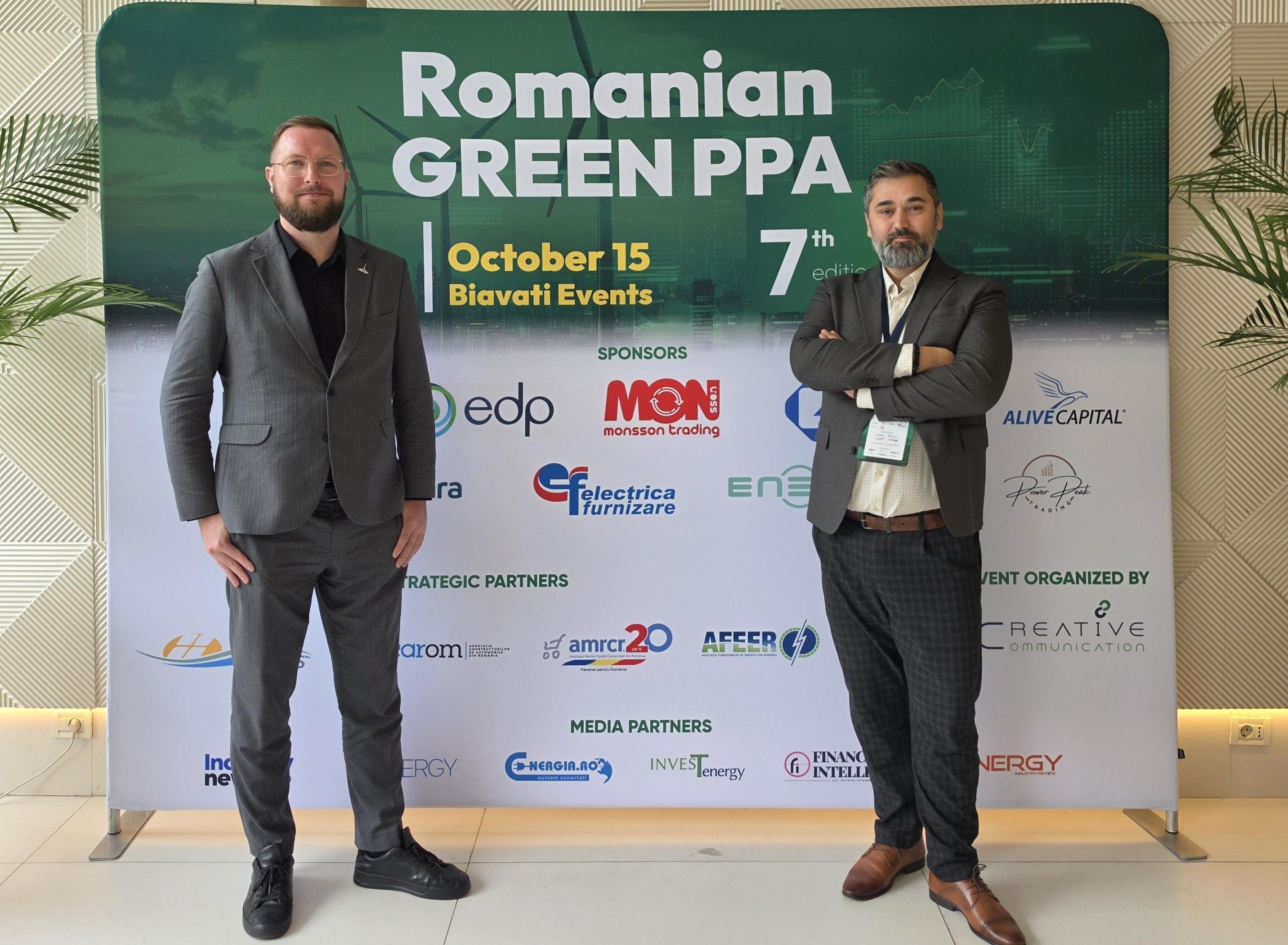
On 15 October 2026, D.TRADING attended the seventh edition of Romanian Green PPA in Bucharest. The conference gathered renewable energy developers, industrial energy buyers, traders, technology providers and financing specialists. The common question was how to turn renewable generation into long-term contracted value. Ionut Ludovic Iancu and Szymon Wojtkowski, both Senior Power Originators, represented D.TRADING. Six themes stood out. They covered risk allocation in PPAs, hybrid wind-solar-storage contracts, commercial models for battery storage, industrial flexibility, guarantees of origin and meeting partners in person.
Romanian Green PPA 2026 at a glance
| Event | Romanian Green PPA, 7th edition |
| Date | 15 October 2026 |
| Venue | Biavati Events, Bucharest, Romania |
| Participants | Renewable developers, energy buyers, traders, technology providers, financiers |
| D.TRADING team | Ionut Ludovic Iancu, Szymon Wojtkowski |
| Main topics | PPA structuring, hybrid PPAs, BESS revenue models, industrial flexibility, guarantees of origin |
Why the Romanian PPA market is on the agenda
Romania is adding renewable capacity at a pace that makes offtake a central commercial question. Transelectrica connected 1,331 MW of solar and 496 MW of wind to the grid between January and 20 August 2026. Each new megawatt needs a buyer or a route to market. The contract terms decide how much price, volume and profile risk stays with the project.
Romania is one of D.TRADING's priority markets in South-Eastern Europe. Between December 2025 and January 2026 the company signed three renewable agreements in the country. They include a power purchase agreement with EDP for 200 GWh of clean electricity per year, a 110 MW wind and solar offtake with Eurowind Energy and a 200 MW solar offtake with Econergy.
"Romania is one of our priority markets. We see strong potential both in the country's economy and in the continued growth of the renewables sector," said Stanislav Dudka, Head of Power Desk Europe at D.TRADING, at ZF Power Summit 2026.
Takeaway 1: How are risks shared in a PPA?
Buyers at the conference still named price predictability as their first objective. Many also want renewable output that follows their consumption profile more closely. That moves the negotiation beyond the price per megawatt-hour. Speakers discussed how producers, traders, suppliers and buyers split four types of risk. The split decides whether an agreement stays commercially viable and acceptable to lenders.
| Risk | What it covers | Pay-as-produced PPA | Baseload or shaped PPA |
| Price risk | Market price moves against the contract price | Fixed for both parties by the contract price | Fixed for both parties by the contract price |
| Volume risk | The asset produces more or less than expected | Carried mainly by the buyer | Carried mainly by the producer or its trader |
| Profile risk | Production hours differ from consumption hours | Carried mainly by the buyer | Carried mainly by the producer or its trader |
| Imbalance risk | Forecast errors settled on the balancing market | Allocated by contract, often to a trader or balancing party | Allocated by contract, often to a trader or balancing party |
The exact split depends on each agreement. A trader often sits between the two sides: it takes variable renewable output, manages balancing and forecasting, and delivers firmer volumes to the buyer.
Takeaway 2: Hybrid PPAs combine wind, solar and storage
Rezolv presented a PPA structure that combines wind, solar and battery storage in a single contract. Solar and wind produce in different hours, and a battery can shift part of the output into periods of higher demand. Together they bring the delivered profile closer to a buyer's load than a single technology can.
Hybrid structures open room for tailored offtake. A residual gap between supply and demand remains, and someone still has to manage that supply and profile risk through balancing, hedging or additional purchases.
Takeaway 3: Commercial models for battery storage
The BESS sessions compared merchant optimisation across energy and balancing markets with contracted revenue models. Each model strikes a different balance between revenue predictability and market exposure.
| Model | How it works | Revenue predictability | Market exposure for the owner | Typical tenor at D.TRADING |
| Route-to-market optimisation | A trader dispatches the battery across energy and balancing markets on the owner's behalf | Lower | Full | Agreed per project |
| Floor with upside sharing | The owner receives a contractual revenue floor plus a share of market revenue above it | Medium | Partial | 3 to 7 years |
| Full tolling | The owner receives a fixed capacity payment in exchange for dispatch rights | Higher | Minimal | 5 to 8 years |
Speakers also stressed timing. The commercial strategy should be agreed early in development, because the asset's technical design, control systems and data interfaces need to support the planned contract. D.TRADING offers these structures, along with hybrid solar-plus-storage contracts, through its BESS solution.
Takeaway 4: Industrial consumers become active market participants
VoltLink described how industrial consumers can combine on-site generation, batteries and flexibility in equipment they already operate. This helps them manage electricity costs and earn revenue from flexibility services.
The opportunity differs from site to site. Consumption profile, operational requirements and grid connection determine how much flexibility a plant can offer. Romanian regulation is moving the same way. On 19 August 2026, ANRE approved a consumption flexibility service: consumers can be paid through Transelectrica auctions for voluntarily reducing demand.
Takeaway 5: Guarantees of origin belong in the PPA
AIB's presentation focused on guarantees of origin (GOs) as the instrument that documents renewable electricity consumption and carries its own commercial value. Participants also discussed Romania's ongoing preparations for AIB integration, which would connect Romanian GOs with the European certificate system.
For PPA parties, the practical point is contractual clarity. An agreement should state:
- which party owns the GOs linked to the contracted volumes;
- whether GOs are priced within the PPA price or separately;
- how and when GOs are transferred to the buyer;
- how the parties handle changes in GO rules during the contract term.
Takeaway 6: Meeting partners in person
For the D.TRADING team, networking was one of the most valuable parts of the day. Ionut Ludovic Iancu and Szymon Wojtkowski met existing and potential partners in person, including counterparts they had previously worked with only through email and video calls. Meeting in person made it easier to talk openly about potential cooperation.
How D.TRADING works with PPAs and renewable offtake in Romania
D.TRADING connects renewable producers, storage owners and energy buyers through offtake structures, market access and risk management. In Romania and across the CESEE region, the company offers:
- PPAs and renewable offtake for wind, solar and hybrid projects, including pay-as-produced and shaped structures;
- balancing and forecasting for renewable producers, with imbalance settlement handled on the producer's behalf;
- guarantees of origin across the full cycle: registration, trading and reporting;
- tranche-based hedging for industrial consumers who fix electricity volumes step by step instead of buying at spot prices;
- BESS contracts: route-to-market optimisation, floor with upside sharing, full tolling and hybrid solar-plus-storage structures.
Agreements are concluded under EFET or ISDA master agreements. Learn more about D.TRADING's power trading and PPA services.
FAQ
What is Romanian Green PPA?
Romanian Green PPA is an annual conference in Bucharest on power purchase agreements, renewable generation and energy storage. The seventh edition took place on 15 October 2026 at Biavati Events and brought together developers, energy buyers, traders, technology providers and financiers.
What PPA structures are used in Romania?
The main structures are pay-as-produced PPAs, where the buyer takes the asset's actual output at a fixed price, and baseload or shaped PPAs, where the seller delivers a fixed profile. Producers can also sell through offtake agreements with balancing services or combine generation and storage in hybrid contracts.
What is a hybrid PPA?
A hybrid PPA combines output from more than one technology, such as wind, solar and battery storage, in a single contract. The mix brings the delivered profile closer to the buyer's consumption, while the remaining profile risk still needs to be managed.
What is a BESS tolling agreement?
In a tolling agreement, the battery owner receives a fixed capacity payment and transfers dispatch rights to the offtaker, who trades the asset. D.TRADING's full tolling contracts typically run 5 to 8 years.
Who owns guarantees of origin in a PPA?
Ownership depends on the contract. The PPA should state which party owns the GOs, whether they are priced separately and how they are transferred, so that the buyer can document renewable consumption.
Which PPA services does D.TRADING offer in Romania?
D.TRADING signs PPAs and offtake agreements with wind, solar and hybrid producers, provides balancing and GO management, offers tranche-based hedging for industrial consumers and structures BESS contracts. Agreements run under EFET or ISDA.


