Romania's Transgaz Cleared to Offer Gas Export Capacity to Ukraine as the European Commission Modifies Its 2020 Antitrust Commitments
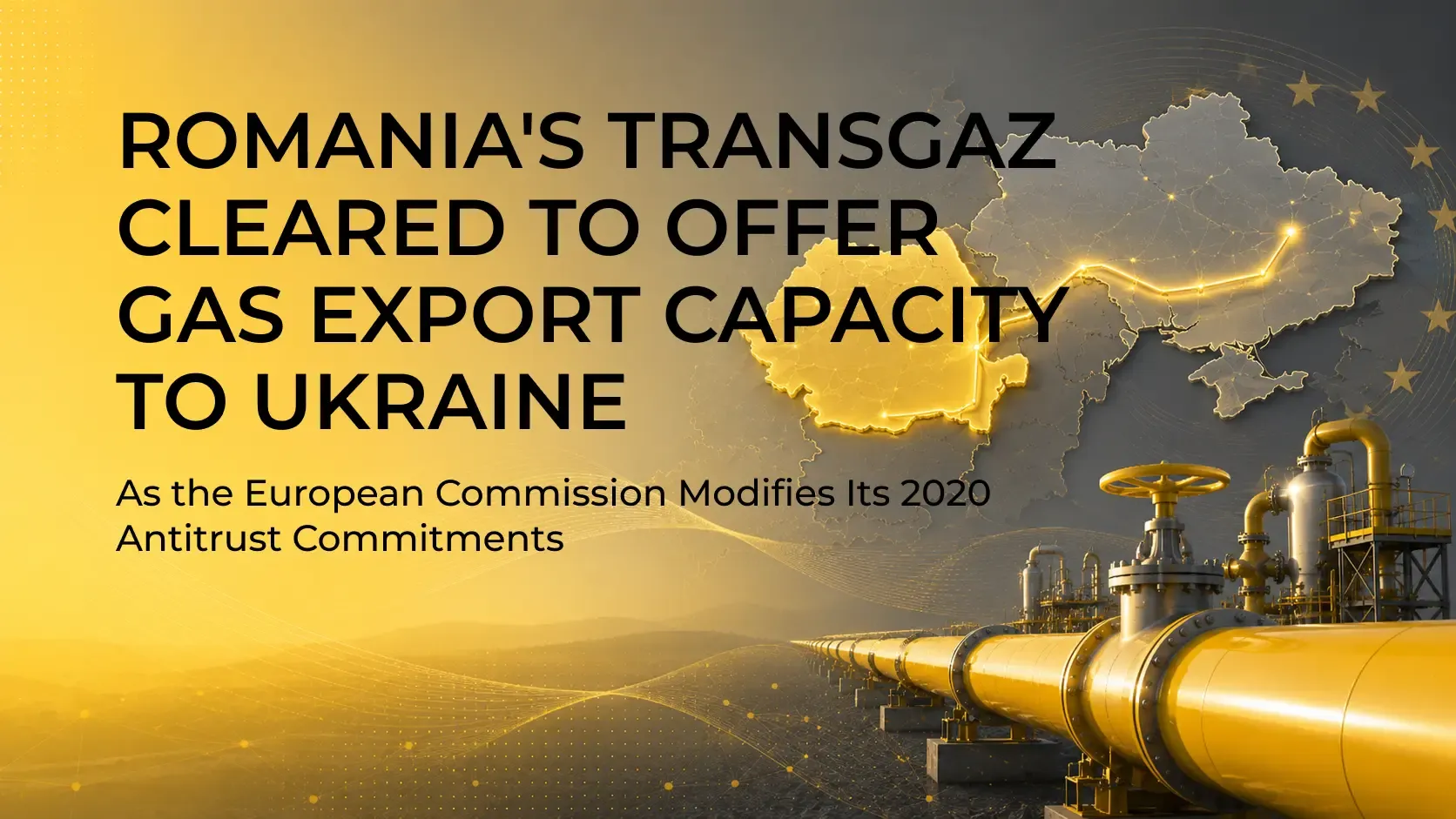
On 5 June 2026, the European Commission said it had approved a modification to the antitrust commitments of Transgaz, the Romanian gas transmission system operator, that lets the company offer pipeline export capacity to Ukraine. The original commitments, given in 2020, limited those export-capacity offers to neighbouring EU member states. The modified commitments apply until 31 December 2026 and fall under case AT.40335, “Romanian gas interconnectors,” in the European Commission’s public case register.
What the European Commission approved
The European Commission approved a change to the binding antitrust commitments that govern how Transgaz offers gas export capacity from Romania. Under the original commitments, dated March 2020, the Romanian transmission system operator made export capacity available to neighbouring EU member states. The modification lets Transgaz also offer export capacity toward Ukraine, a country outside the EU, alongside the existing arrangements. The European Commission announced the modification on 5 June 2026. .
The 2020 commitments that the modification changes
The modification rests on antitrust commitments that Transgaz first gave to the European Commission in March 2020. Those commitments closed case AT.40335, “Romanian gas interconnectors,” an investigation under Article 102 of the Treaty on the Functioning of the European Union into whether Transgaz had restricted natural gas exports from Romania. To resolve the European Commission’s concerns, Transgaz committed to making firm export capacity available at interconnection points with neighbouring EU member states, including Hungary and Bulgaria. The 2020 commitments did not extend those capacity offers to Ukraine, which sits outside the EU.
What Transgaz requested in May 2026
Transgaz asked the European Commission in May 2026 to let it offer competing export capacities at two interconnection points. One point sits on the Romania–Bulgaria border; the other sits on the Romania–Ukraine border, on the same gas pipeline. The request sought to allow competing export capacities toward Ukraine and Bulgaria. The 2020 commitments contained a review clause, and Transgaz used that clause to bring the request.
How the European Commission assessed the request
The European Commission assessed the Transgaz request under the review clause written into the March 2020 commitments. The European Commission concluded that Transgaz had shown good cause to modify the commitments, and that the change stayed consistent with the original objective of opening Romanian gas exports to competition.
The stated aim: a regional gas market and diversified supply to Ukraine
The European Commission framed the modification as a step toward a regional gas market and a more diversified supply to Ukraine. According to the Commission’s statement, offering export capacities to Ukraine is intended to contribute to the development of a regional gas market and to diversifying the country's gas supply. The European Commission presents this as the purpose of the change rather than a measured result. The documented mechanism is the offer of competing export capacities at the relevant interconnection points.
Competing export capacities at two interconnection points
The modified commitments turn on competing export capacities at two interconnection points. Transgaz will offer capacity at the Romania–Bulgaria interconnection point and at the Romania–Ukraine interconnection point, with the two routes drawing on the same gas pipeline. Competing capacities are capacities that cannot be allocated at one point without fully or partly reducing the capacity offered at the other point.
What the decision could mean for market participants
For traders and shippers moving gas across South-Eastern Europe, the decision opens a regulatory path to offer Romanian pipeline export capacity toward Ukraine that the 2020 commitments did not allow. Counterparties supplying Ukrainian buyers can factor the Romania–Ukraine interconnection point into planning for the period the commitments run. The modification concerns the antitrust framework around capacity offers; it does not by itself create volumes, set prices, or guarantee flows, each of which depends on capacity allocation and market demand at the interconnection points.
Frequently asked questions
What changes for gas exports to Ukraine?
Transgaz may now offer competing export capacities at the Romania–Ukraine interconnection point, which the 2020 commitments had not covered; the Romania–Ukraine and Romania–Bulgaria routes draw on the same gas pipeline.
Why did the original 2020 commitments exist?
The 2020 commitments closed European Commission case AT.40335 under Article 102 TFEU, which examined whether Transgaz had restricted natural gas exports from Romania; Transgaz committed to make export capacity available to neighbouring EU member states to resolve the concerns.
Do the modified commitments specify any gas volumes for Ukraine?
The statement records that Transgaz will offer the possibility of export capacities to Ukraine and does not state specific volumes for the route, so the volume that reaches Ukraine depends on auction allocation and demand.
Source
European Commission, case AT.40335, “Romanian gas interconnectors.” The public competition case register lists the 2020 commitment decision and the 5 June 2026 press communication on the case page at competition-cases.ec.europa.eu.
Disclaimer
This article is prepared by D.TRADING for general informational purposes only and does not constitute legal, financial, investment, accounting, tax, or regulatory advice. The information contained herein is based on publicly available sources and reflects opinion on the regulatory environment as of the publication date. D.TRADING makes no representations or warranties, express or implied, as to the accuracy, completeness, or timeliness of the information provided. This document is not an offer or solicitation to buy or sell any energy products, commodities, or financial instruments.
About D.TRADING
D.TRADING is a B2B energy trading company operating across Central, Eastern, and South-Eastern Europe, with hubs in Baar (Switzerland), Zagreb (Croatia), Amsterdam (Netherlands), and Kyiv (Ukraine).
The company trades power, gas, LNG, and fuels for enterprise and wholesale counterparties, with services that include structured trading, renewable offtake, battery storage route-to-market, and guarantees of origin.


