
BESS in Southeast Europe: Key Takeaways from RENPOWER Greece 2026
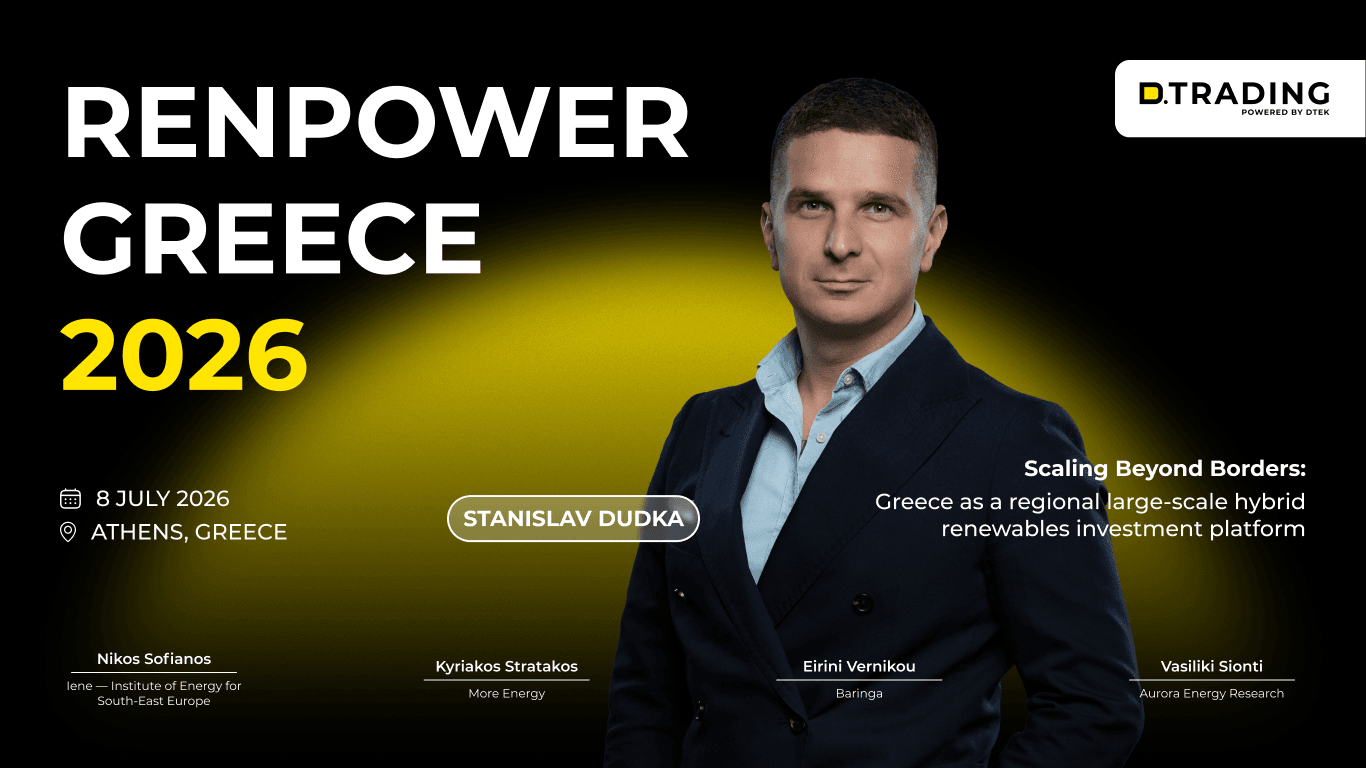
Battery storage economics, cross-border trading and market integration will define the next phase of Southeast Europe's energy transition. That was D.TRADING's message at RENPOWER Greece 2026, held in Athens on 8 July 2026, where BESS dominated the agenda.
D.TRADING joined the panel "Scaling Beyond Borders: Greece as a Regional Large-scale Hybrid Renewables Investment Platform", where Stanislav Dudka, Head of Power Desk Europe at D.TRADING, examined those three forces. The session was moderated by Nikos Sofianos, Secretary General and Head of the RES & Battery Committee at the Institute of Energy for South-East Europe (IENE), and brought together representatives of Motor Oil Renewable Energy (MORE), Baringa, Aurora Energy Research and D.TRADING.
Why Battery Storage Now Defines the Region's Energy Agenda
The question in Southeast Europe is no longer how to add renewable generation capacity - it is how electricity markets can absorb rising volumes of variable output. The European Commission estimates that flexibility needs in the EU electricity system will reach 288 TWh by 2030, equal to around 24% of total EU electricity demand, and that Europe will require more than 200 GW of energy storage capacity by 2030 and 600 GW by 2050, up from roughly 89 GW in 2024.
Battery storage absorbs surplus midday solar generation and releases it during evening peaks, which reduces curtailment and stabilises revenues for renewable producers. Greece illustrates the cost of not having it: in 2025 the country reportedly curtailed around 1,867 GWh of renewable generation, about 6.6% of total renewable output, while hours of zero or negative wholesale prices more than doubled to 483.
How BESS Revenue Models Evolve as Deployment Grows
Battery storage projects in European power markets typically stack revenues from several sources: ancillary services such as frequency regulation, arbitrage between low and high prices in day-ahead and intraday markets, and balancing market participation. The weight of each revenue stream shifts as installed capacity grows.
Stanislav Dudka told the panel that timing determines how much value a battery project captures.
Investors entering Southeast Europe today face a compressed version of a cycle that has already played out in more mature storage markets: early entrants capture strong ancillary service margins, saturation compresses those margins, and returns migrate to energy trading across multiple market segments. Structured BESS offtake and revenue solutions, from tolling agreements to floor structures, allow investors to manage this transition without carrying full merchant risk.
Greece, Bulgaria, Romania: One Region, Three Speeds
National storage markets in Southeast Europe are scaling at different rates. Bulgaria's National Energy and Climate Plan sets a 2030 battery storage target of 1.28 GW, yet state-backed auctions have already awarded capacity well beyond that level, and Romania continues to commission merchant projects at pace. Greece targets 4.3 GW of energy storage by 2030 under its NECP, but grid connection queues and project financing delays hold back a permitting pipeline that has grown to roughly 12 GW.
Dudka argued that these national trajectories can no longer be assessed in isolation.
Regional power trading strategies that span multiple bidding zones capture value that single-market positions miss. Storage capacity commissioned in Bulgaria flattens price spreads that Greek and Romanian assets rely on, and interconnector flows transmit those effects across borders within hours.
Conditions for the Next Investment Wave
Four factors will determine whether that appetite converts into commissioned projects: faster battery deployment, expanded grid infrastructure, stronger regional interconnections and market frameworks that give investors long-term certainty. The panel concluded that investor appetite across Southeast Europe remains strong. Greece holds the fundamentals of a regional energy hub, including its location, resource base and growing interconnections, but the pace of grid connections will decide how much of its pipeline reaches operation before regional competition reshapes project economics.
BESS Market Fundamentals: Quick Answers
What is a battery energy storage system (BESS)?
A battery energy storage system (BESS) is a grid-connected installation that stores electricity, typically in lithium-ion batteries, and discharges it when the system needs power. In renewable-heavy markets, BESS absorbs surplus generation during peak solar or wind hours and releases it when prices and demand rise, which reduces curtailment and supports grid stability.
How do BESS projects earn revenue in European power markets?
BESS projects stack revenues from ancillary services (such as frequency regulation), price arbitrage in day-ahead and intraday markets, and balancing market participation. Early-stage markets reward ancillary services most; as storage capacity grows, returns shift towards energy trading across multiple market segments.
Why does early market entry matter for battery storage investors?
Ancillary service revenues are highest when few batteries compete for them. As deployment accelerates, these revenues compress and project economics shift towards day-ahead, intraday and balancing markets. Projects that enter early capture the strongest margins and have more time to diversify revenue strategies.
What are the 2030 energy storage targets in Southeast Europe?
Greece targets 4.3 GW of energy storage by 2030 under its National Energy and Climate Plan. Bulgaria's NECP sets a 1.28 GW battery storage target, which awarded capacity has already exceeded. The European Commission estimates the EU as a whole will need more than 200 GW of storage by 2030.


