Accelerate EU: The European Commission's Energy Crisis Response Plan — Key Facts for Energy Market Participants
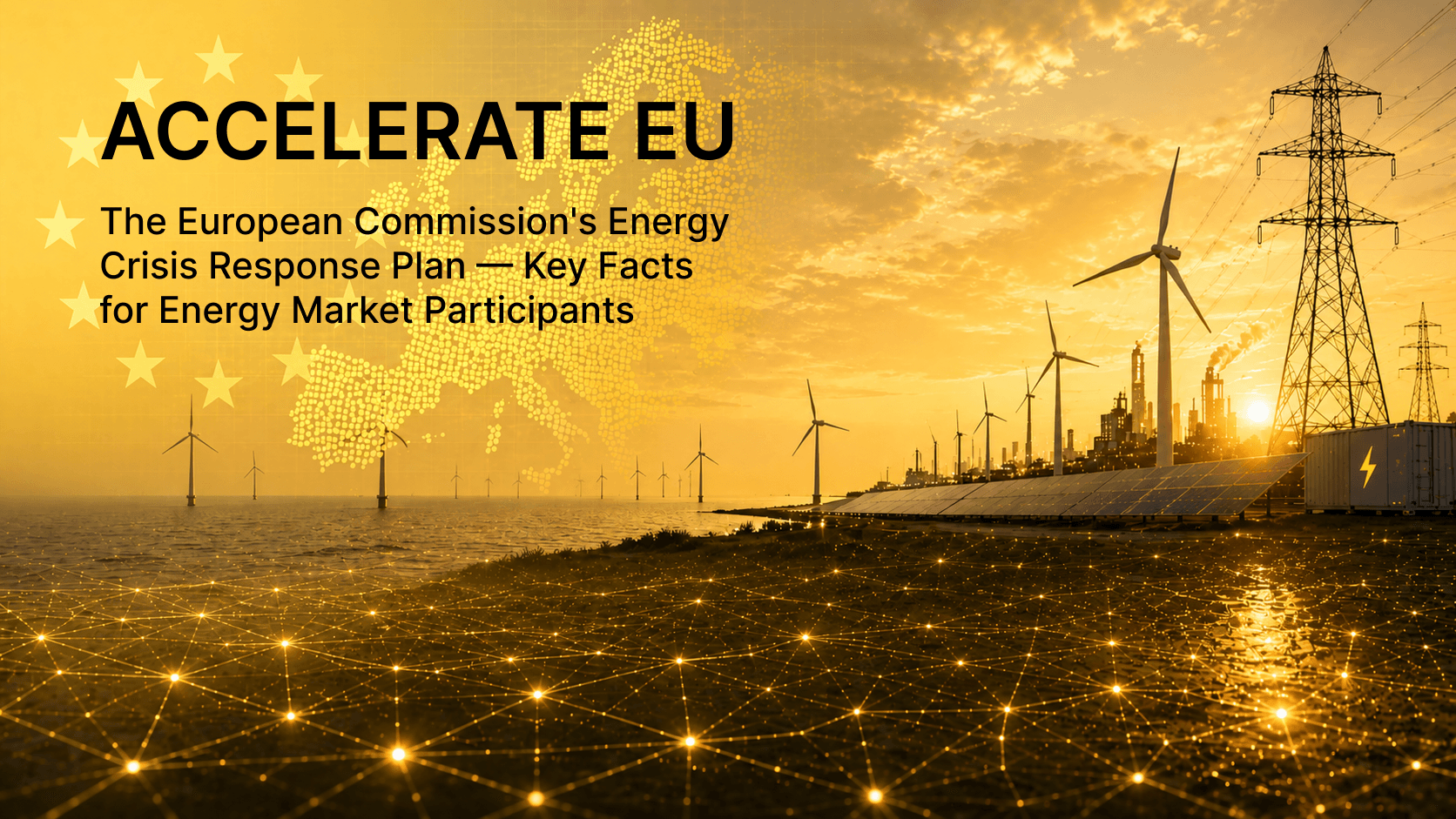
On 22 April 2026, the European Commission published the Accelerate EU plan — a policy response to the energy shock triggered by the war in Iran and the blockade of the Strait of Hormuz. The plan combines short-term coordination measures with structural initiatives to accelerate the EU's shift to homegrown clean energy.
The Commission estimates the EU has spent an additional €24 billion on energy imports since the conflict started, reflecting higher prices and tighter supply. The plan is explicitly framed as an attempt to turn the crisis into a catalyst for structural change, not solely an emergency response.
Commission President Ursula von der Leyen stated the bloc must accelerate the shift to domestic and clean energy to strengthen energy security and reduce dependence on imports. Executive Vice-President Teresa Ribera said there was 'no alternative' to the Green Deal.
The Plan at a Glance
- Published: 22 April 2026, European Commission
- Short-term structure: Three coordination areas — supply/storage, consumer protection, demand reduction
- Renewable deployment target: 100 GW annual renewable electricity deployment
- ETS update: Legislative proposal by July 2026; Industrial Decarbonisation Bank (€100bn) + Investment Booster (400mn allowances)
- Electrification Action Plan: To be presented by summer 2026
Context: What Triggered AccelerateEU
The Strait of Hormuz blockade has created a supply disruption affecting global LNG flows and driving up European energy prices. AccelerateEU builds on President von der Leyen's announcement at the March 2026 European Council and follows the Middle East Crisis Temporary State Aid Framework (METSAF) outlined on 13 April 2026.
The plan sits within a longer policy sequence: the Action Plan for Affordable Energy (February 2025), the European Grids Package (December 2025), and the Clean Energy Investment Strategy (March 2026) all preceded AccelerateEU and inform its structural measures.
AccelerateEU uses the Iran crisis as a lever to accelerate the electrification agenda — an objective the Commission has sought to advance for years.
Short-Term Key Measures: Three Coordination Areas
The Commission's immediate action is structured around three key coordination areas. Most short-term implementation responsibility rests with national governments — the Commission's direct levers are limited to coordination, state-aid regulation, and recommendation.
| Short-Term Area | Measures Proposed |
|---|---|
| 1. Supply and storage coordination | Coordinate refilling of underground gas storage ahead of winter. Promote joint oil and gas purchasing. Launch a new EU Fuel Observatory from May 2026 to track EU production, imports, exports, stocks of transport fuels, refining capacity, and military fuel stocks. Coordinate with fuel suppliers, airports, and airlines on alternative jet fuel supply; assess whether jet fuel should be included in obligatory strategic stocks. |
| 2. Consumer and industry protection | Deploy targeted relief measures: income support schemes, energy vouchers, social leasing schemes for clean technologies. State Aid Temporary Framework (METSAF) provides additional flexibility for national governments to support the most exposed sectors. Member states may also take measures to tax windfall profits of energy firms 'to ensure social fairness'. |
| 3. Voluntary demand reduction | Foster coordinated voluntary demand reduction across member states during supply disruption. Social leasing schemes for clean technologies (e.g. electric vehicles, etc.) identified as delivery mechanism. |
Structural Measures: Long-Term Acceleration
The structural component of AccelerateEU — which the Commission describes as its most important element for long-term energy security — covers electrification, grid investment, renewable deployment, ETS reform, and investment mobilisation.
| Structural Measure | What It Includes |
|---|---|
| Electrification Action Plan | To be presented by summer 2026, with a new EU electrification target and measures to remove barriers in industry, transport and buildings. It will also include proposals on network charges and lower taxation of electricity compared to fossil fuels. |
| Grid investment and European Grids Package | Full implementation of existing rules and rapid agreement on the European Grids Package. Focus on better use of current renewable infrastructure and repowering wind and offshore projects, supported by a major increase in CEF Energy funding for cross-border grids. |
| Renewable deployment target | Raise annual renewable electricity deployment to 100 GW to reduce reliance on imported fossil fuels. |
| EU ETS update | By July 2026, update the EU Emissions Trading System to strengthen clean energy financing through the Industrial Decarbonisation Bank and the Investment Booster, with revised benchmarks to follow. |
| Clean energy investment mobilisation | Implement the Clean Energy Investment Strategy to help meet annual investment needs to 2030, using EU funds, EIB support and a Strategic Infrastructure Investment Fund, and by bringing together public and private investors at a Clean Energy Investment Summit. |
| Small Modular Reactors (SMRs) | Deploy first operational SMRs in the early 2030s, backed by additional EU support and guarantees to de-risk initial commercial projects. |
| Sustainable transport fuels | Speed up deployment of sustainable aviation and maritime fuels through the Sustainable Transport Investment Plan, with extra support considered under the ETS. |
About D.TRADING
D.TRADING is an international energy supplier and trading company operating across 25 countries, with physical local supply capabilities in 17 markets and access to 22 exchanges and trading platforms across Europe. The company's commodity portfolio spans wholesale electricity, natural gas, LNG, and petroleum products, with strategic operational hubs in Baar (Switzerland), Zagreb (Croatia), Amsterdam (the Netherlands), and Kyiv (Ukraine).
The company's power trading desk is active in day-ahead, intraday, and balancing markets across Central, Eastern, and South-Eastern Europe. In natural gas and LNG, D.TRADING operates along the key supply corridors connecting Southern and Northern European entry points with demand centres across the region. D.TRADING's service portfolio includes structured trading, renewable energy offtakes, Guarantees of Origin (GoO), energy procurement, risk management, and regulatory reporting.
In 2024, D.TRADING's total power trading volume reached 8.3 TWh and gas trading volume reached 7.0 TWh. The company serves more than 130 clients with tailored trading solutions and market access across Europe.
Disclaimer
This article is prepared by D.TRADING for informational purposes only and does not constitute legal, financial, investment, accounting, tax, or regulatory advice. The information contained herein is based on publicly available sources and reflects opinion on the regulatory environment as of the publication date. D.TRADING makes no representations or warranties, express or implied, as to the accuracy, completeness, or timeliness of the information provided.
Nothing in this article should be construed as an offer to buy or sell any financial instrument, energy product, or commodity, nor as investment advice within the meaning of MiFID II or any other applicable legislation. Readers should seek independent professional advice before making any procurement, trading, or investment decisions or any other use of this article and its content.
Regulatory frameworks referenced in this article, are subject to ongoing legislative development. D.TRADING, its directors, employees, agents, affiliates, advisors and/or representatives assumes no liability for the content and any decisions made on the basis of this content.


