
Risk Is No Longer Modeled - It’s Executed
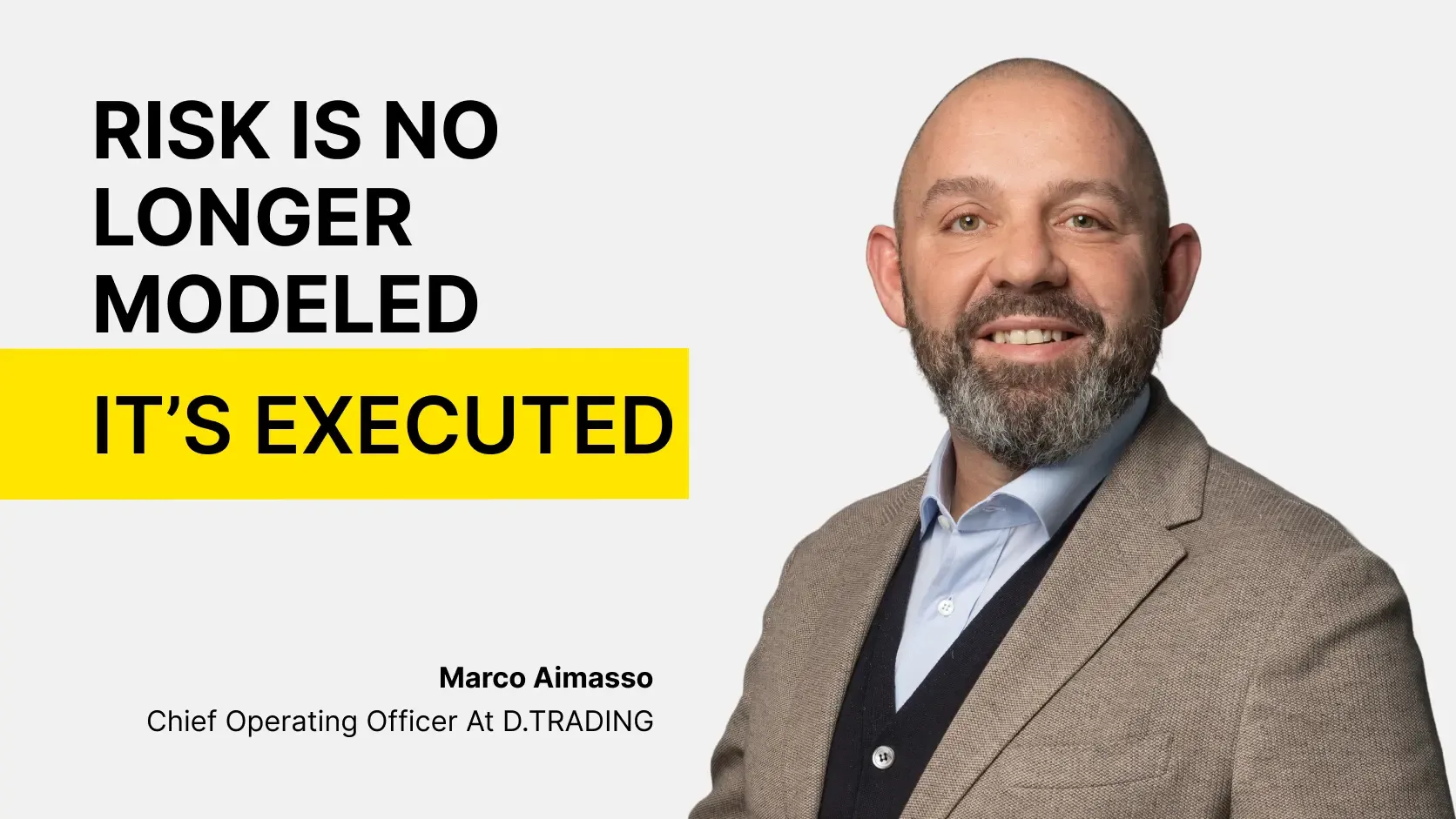
For most of my career, trading commodities and building risk frameworks in European utilities to managing global portfolios across gas, power, and LNG, risk was something that could be modeled, measured, and optimized as a source of value creation.
That assumption no longer holds.
What we face today is not simply higher volatility, but a structural shift in how risk is created, transmitted, and managed across the global energy system — extending well beyond trading books into analytics, logistics, execution, and infrastructure.
From Models to Physical Reality
Recent events in the Gulf have fundamentally started to rewrite the global LNG balance. Disruptions affecting up to 20% of global LNG supply linked to Qatar’s Ras Laffan complex pushed the market from surplus assumptions into a potentially structural and long-lasting deficit, almost overnight.
This was not a pricing shock. It was a system shock.
Analytics Under Stress
Market analytics remain essential, but their role has fundamentally changed. Forecasting today is less about precision and more about resilience, framing ranges, stress‑testing assumptions, and identifying where systems fail.
The key question is no longer, “What is the most likely price?”
It is, “Where does the system break under strain?”
And critically, “How quickly can we respond when it does?”
Markets Need Logistics
Having overseen big portfolios exceeding billions of euros in Value‑at‑Risk, one principle remains constant: markets only clear efficiently when logistics do.
That condition is weakening.
Disruptions to key shipping routes may add 8–10 days to LNG voyages, effectively reducing global fleet availability by 5–7%. That impact is not merely physical; it directly erodes market liquidity. Fewer movable cargoes mean thinner screens, wider bid‑ask spreads, and sharper intraday dislocations. This tightening cannot obviously be hedged on a screen.
As a result, dispatching and logistics have moved to the center of market risk and opportunity. Routing decisions, scheduling flexibility, and execution quality increasingly determine outcomes as much as price direction — often within the trading day itself.
In this environment, reliance on spot liquidity is no longer optimization. It is vulnerability.
CESEE and Power Markets: Execution Risk
Central, Eastern, and South‑Eastern Europe combine rising integration with EU markets and persistently uneven infrastructure and liquidity. Ukraine’s roughly 30 bcm of gas storage capacity is among the largest in Europe, yet corridor inefficiencies and layered tariffs can erode competitiveness by 10–20% compared with alternative routes. These frictions are rarely visible in curves, but they dominate delivery, making access and execution more critical than nominal price signals.
Power markets exhibit the same dynamics. Rapid renewable growth has weakened price formation, with wind and solar capture rates declining by 10–30% year‑on‑year across several European markets. Intraday spreads are widening, negative prices are becoming more frequent, and imbalance costs are rising. Battery storage addresses these dynamics only when tightly integrated with analytics and dispatch, where execution speed, not asset ownership, determines returns.
The Control Layer
As risk has become more operational, IT and operational systems have effectively become market infrastructure. Trade capture, nominations, scheduling, confirmations, settlements, and data flows now form the organization’s control layer, the point where market exposure is either contained or amplified.
In stressed markets, latency is risk. Data breaks translate directly into exposure. Weak controls turn volatility into loss. Increasingly, resilience is determined not by the sophistication of trading strategies, but by the reliability, speed, and automation of the underlying systems.
This is where advanced analytics and AI play a growing role, not as forecasting tools, but as safeguards. Automating reconciliations, detecting anomalies in real time, and prioritizing operational decisions under stress are becoming critical to preserving value when markets move faster than manual processes can respond.
In today’s environment, a robust control layer is no longer a cost of doing business.
It is a prerequisite for operating in the market.
What awaits
The next 12–36 months will be defined by competition for three scarce assets: molecules, infrastructure access, and operational flexibility.
For Europe, this means securing diversified and reliable supplies beyond price signals alone.
For CESEE, it means converting connectivity into genuine liquidity and deliverability.
For market participants, success will hinge on how effectively risk is managed through execution, translating access, speed, and control into commercial outcomes.
In a system where volatility is structural, execution has become strategy.
Conclusion
Risk has not increased.
It has changed dimension.
What was once managed at the edge of the portfolio has moved to the center of the system. Risk now materializes where markets meet reality, in dispatch rooms, control systems, and execution decisions made under time pressure.
Those who recognize this shift will do more than follow the market.
They will define it.


