Greece RED III and Battery Storage: What the Licensing Reform Means for Renewable Investors and Offtake Partners
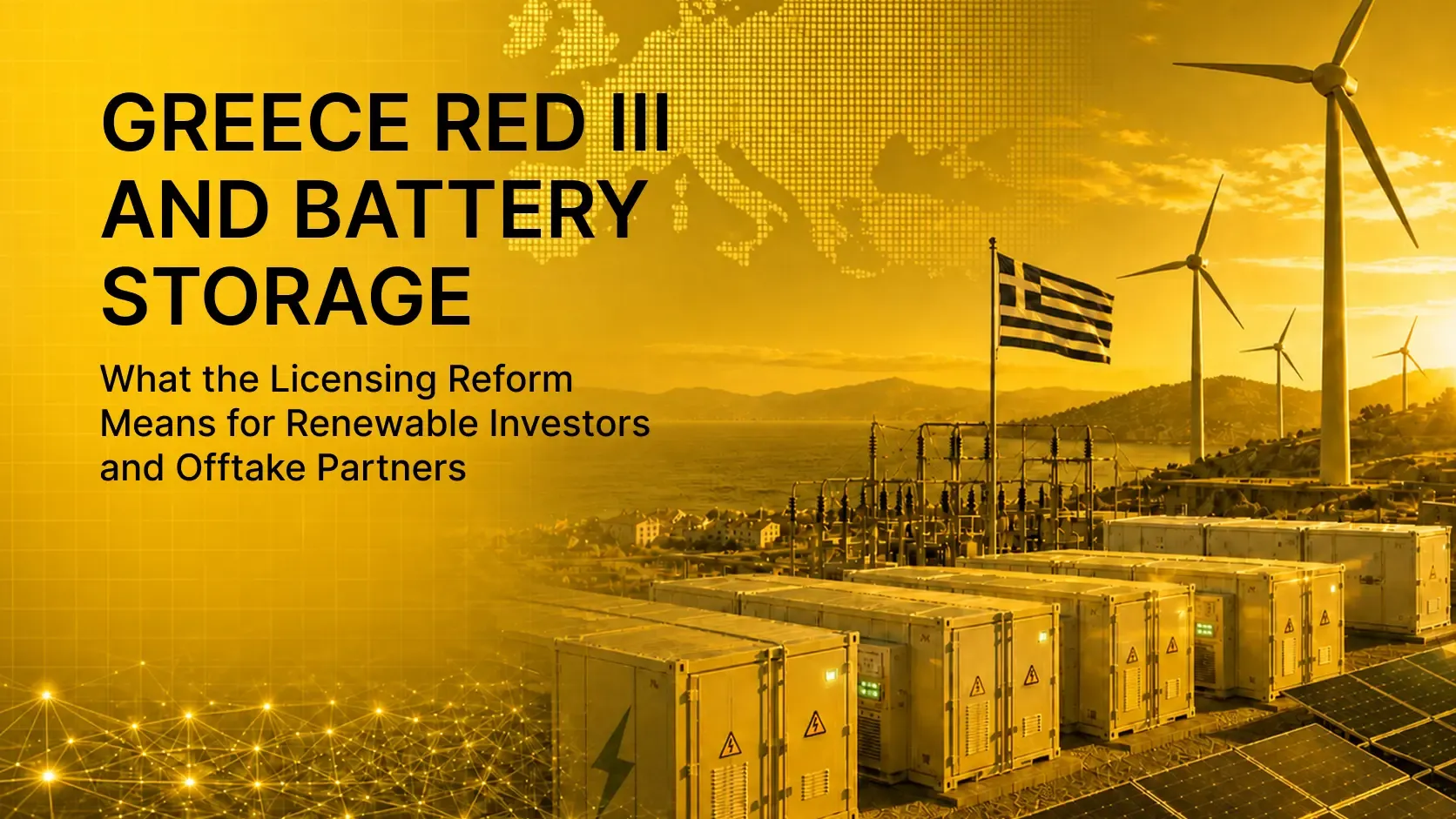
Greece has moved to integrate the EU's Renewable Energy Directive (RED III) through a comprehensive new bill submitted for public consultation in April 2026 — following repeated warnings from the European Commission. The centrepiece of the reform is a dramatic acceleration of renewable energy permitting: wind farm licensing timelines will be cut from up to 10 years to a maximum of 1.5 years.
Alongside the permitting overhaul, the bill introduces specific protections for battery energy storage investors — most notably the right to retain guarantee letters until grid connection regardless of grid construction delays. With 700 MW of supported BESS targeted for completion by July 2026 and the first standalone batteries already operational in day-ahead and intraday markets, Greece is entering a new phase of its energy transition.
For renewable investors, BESS developers, and offtake partners evaluating the Greek market, the RED III reform removes the single largest barrier to project development — permitting uncertainty — and replaces it with a time-bound, legally enforceable framework. The investment window is open.
Greece Energy Reform: The Numbers Behind the Headlines
- Wind farm permitting: Reduced from up to 10 years to maximum 1.5 years
- RED III integration: New bill in public consultation — aligns Greece with EU standards after EC infringement warnings
- Go-to areas: Designated zones for renewable projects with fastest permitting pathway
- Investor compensation: State and local authorities must compensate investors for delays beyond statutory permitting timelines
- BESS guarantee letters: Retained until grid connection regardless of grid work delays
- First operational standalone BESS: 2 units, 16 MW — active in day-ahead and intraday markets (April 2026)
- Near-term BESS pipeline: ~300 MW expected online by end of April 2026; 700 MW supported total by July 2026
The Permitting Bottleneck: Why 10 Years Was Unacceptable
Greece's renewable energy sector has one of the most compelling natural resource profiles in Europe: among the highest solar irradiance on the continent, strong and consistent Aegean wind resources, and substantial island grid opportunities for hybrid RES-storage systems. Yet development has been chronically underdelivered relative to this potential — largely because permitting timelines of up to a decade made Greek projects unfinanceable against competing opportunities in faster-moving European markets.
The European Commission issued multiple warnings to Greece for failing to transpose RED III — the directive that sets maximum permitting timelines across EU member states. The new bill is Greece's response: a legislative overhaul that brings national permitting law into alignment with EU standards and, critically, introduces enforcement mechanisms that did not previously exist.
The compensation obligation is the key enforcement innovation: if national or local licensing authorities exceed the statutory timeline, investors are entitled to compensation. This transforms permitting timelines from aspirational targets into legally binding commitments — a structural change that materially reduces development risk for project finance purposes.
What Changes: Before and After RED III
| Parameter | Previous Framework | After RED III Reform |
|---|---|---|
| Wind farm permitting | Up to 10 years | Maximum 1.5 years |
| Go-to areas for renewables | No designated fast-track zones | Specified go-to areas introduced — streamlined approval for projects in designated zones |
| Repowering of existing units | Standard permitting process | Dedicated faster pathway for repowering existing RES assets |
| Investor compensation for delays | No compensation obligation | State and local licensing bodies must compensate investors for delays beyond statutory timelines |
| BESS guarantee letters | Letters of guarantee expire if grid works delayed | Investors may retain guarantee letters until grid connection, regardless of grid work delays |
| RED III compliance | Not yet integrated — EC warnings issued | Full integration via new bill — aligns national legislation with EU standards |
The BESS Pipeline: Where Greece Stands Today
Greece's BESS market is moving from pilot to scale in a compressed timeframe. The first two standalone batteries connected to the grid in April 2026 — totalling just 16 MW — represent proof of concept. What follows in the next three months is an order of magnitude larger.
| Pipeline Stage | Status | Capacity | Notes |
|---|---|---|---|
| Operational (April 2026) | 2 standalone BESS | 16 MW | Day-ahead and intraday market participation confirmed |
| Near-term pipeline | Grid-connected by end of April 2026 | ~300 MW | Expected online imminently per TSO announcements |
| Supported BESS target | Completion deadline July 2026 | 700 MW | Supported under Greek energy storage support scheme |
| Medium-term pipeline | Beyond July 2026 — RED III accelerated projects | Multi-GW | New projects entering fast-track permitting from Q2 2026 |
Market context: Greece's power grid has significant solar saturation in peak summer hours, creating regular negative price events during midday. The BESS deployment pipeline is directly sized to capture this arbitrage — and the RED III reform's go-to area provisions and accelerated repowering pathway will drive a further wave of projects beyond the current supported scheme.
The BESS Guarantee Letter Protection: A Financing Game-Changer
One of the most practically significant provisions in the RED III bill is the protection of guarantee letters for BESS investors against grid construction delays. Under the previous framework, guarantee letters — financial instruments provided by investors to secure grid connection rights — could expire if grid works were delayed beyond the connection deadline, even when the delay was entirely outside the investor's control.
This created a structural financing risk: lenders and equity investors could not rely on grid connection rights being preserved through the construction period if grid infrastructure was delayed. The result was either higher risk premiums in project financing, or projects stalling at the financing stage because lenders required certainty that could not be guaranteed.
The reform eliminates this risk: BESS investors may now retain their guarantee letters until actual grid connection, regardless of how long grid works take. For projects currently in financing or in the pipeline, this is a direct reduction in financing cost and a removal of a condition that was blocking some transactions entirely.
The Solar Negative Price Opportunity: Greece's Structural BESS Advantage
Greece has one of the strongest structural cases for BESS revenue in Southern Europe, driven by its solar generation profile. High solar penetration creates predictable negative price windows during summer midday hours — typically from 11:00 to 15:00 CEST on clear days — when solar output saturates demand and prices drop to zero or below.
- Day-ahead strategy: Negative midday price windows are forecastable 24 hours in advance. BESS operators with sophisticated weather and generation models can pre-position charging cycles to capture the lowest prices of the day.
- Intraday strategy: Solar forecast errors and real-time grid imbalances create intraday negative price spikes that are shorter and more volatile than day-ahead events — but also more extreme. Active intraday trading capability is essential for capturing these events.
- Evening peak discharge: As solar output drops after 16:00 and demand recovers into the evening, Greek day-ahead prices typically spike — creating the discharge window that completes the BESS revenue cycle.
For investors modelling Greek BESS revenue, the combination of the negative price charging opportunity and the evening discharge premium creates a structural daily arbitrage that is more predictable and repeatable than in markets with less pronounced solar profiles. The RED III reform — by accelerating the addition of further renewable capacity — will deepen this arbitrage over time.
Comparing Greece and Bulgaria: Two BESS Markets in Parallel
Greece and Bulgaria are the two most active BESS development markets in Southeast Europe in 2026. While each has distinct characteristics, they share structural drivers that make them compelling together for investors building a regional BESS portfolio.
- Greece: Solar-dominated renewable profile; negative price opportunity concentrated in summer midday hours; RED III reform unlocking a permitting pipeline that was previously blocked; guarantee letter protection now in place for new projects; LNG import capacity at Revithoussa creates additional energy price dynamics.
- Bulgaria: 4 GW BESS pipeline for 2026; new IBEX trading products (Exclusive Groups, Spread Blocks) launching Q2 2026 specifically for storage operators; strong TSO support for storage development; established exchange liquidity with January 2026 intraday record of 6.65 TWh.
For offtake partners, a cross-border Greece-Bulgaria BESS portfolio offers geographic diversification of the negative price capture opportunity — Greek solar negative prices in summer, Bulgarian wind and solar negative prices with different seasonal profiles — and access to two distinct exchange platforms with growing liquidity.
Investor Action Checklist: Evaluating Greek RES and BESS Opportunities
| Investor Checklist Item | What to Verify |
|---|---|
| Is the project in a designated go-to area? | Go-to area projects benefit from the fastest permitting pathway. Confirm with Greek Ministry of Environment and Energy whether the project site falls within a designated zone before committing development costs. |
| Is an offtake agreement in place or in negotiation? | For BESS projects under the supported scheme, an offtake or market access agreement with a qualified trading entity is required for bankability. Confirm offtake partner's HENEX membership, day-ahead and intraday trading capability, and revenue track record. |
| Are guarantee letters structured for grid delay protection? | The RED III reform allows BESS investors to retain guarantee letters until grid connection regardless of grid work delays. Ensure financing documents and guarantee letter terms reflect this new protection — older templates may not include it. |
| Is the revenue model updated for negative price capture? | Greece has regular midday negative price windows in summer due to solar saturation. BESS revenue models should explicitly incorporate negative price charging cycles as a structural component, not a scenario assumption. |
| Is investor compensation for licensing delays documented? | The new law requires compensation if licensing authorities exceed statutory timelines. Document the permitting start date and statutory deadline to preserve the compensation right from Day 1 of the process. |
| Is the project eligible for repowering fast-track? | Existing RES assets at or near end-of-life may qualify for the dedicated repowering pathway — significantly reducing timeline and cost compared to a greenfield application. |
The Broader Signal: Greece as a Regional Energy Hub
The RED III reform does not exist in isolation. It is part of a broader repositioning of Greece as a regional energy infrastructure hub — a role that D.TRADING has been tracking across multiple dimensions:
- LNG gateway: The Revithoussa LNG terminal and the Alexandroupolis FSRU are the primary entry points for LNG into Southeast Europe via the Vertical Gas Corridor — connecting Greece to Bulgaria, Romania, Moldova, and Ukraine.
- Power interconnections: Greece's interconnection capacity with Bulgaria, North Macedonia, Albania, and Turkey positions it as a cross-border power hub as well as a gas transit country.
- Renewable export potential: With accelerated permitting, Greece's solar and wind resources can be developed not only for domestic consumption but for export via cross-border interconnectors — creating long-term offtake opportunities for energy produced in Greece and delivered elsewhere in the region.
The combination of accelerated permitting, BESS investment protection, and the country's strategic infrastructure position makes Greece one of the most important energy markets to be active in across the next five years.
How D.TRADING Works with Greece
D.TRADING is active across the Greek energy market — including renewable offtakes, structured trading on HENEX, and participation in the regional LNG and gas infrastructure that flows through Greek entry points. Our power trading desk provides offtake solutions for wind, solar, and BESS assets, with capabilities across day-ahead, intraday, and balancing markets.
"We create an environment where capital can work efficiently despite market transformations. Our role is to provide investors with a bankable product and a reliable partnership that converts market volatility into consistent performance."
— Stanislav Dudka, Head of D.TRADING Power Desk EU (ZF Power Summit 2026)
For BESS investors and renewable developers evaluating projects in Greece under the new RED III framework, D.TRADING offers market access, bankable offtake structures, and revenue optimisation across the full negative price capture cycle.
This article is the final piece in our April–May 2026 regulatory intelligence series covering energy market developments across Southeast and Central Europe.
Disclaimer
This article is prepared by D.TRADING for informational purposes only and does not constitute legal, financial, investment, accounting, tax, or regulatory advice. The information contained herein is based on publicly available sources and reflects opinion on the regulatory environment as of the publication date. D.TRADING makes no representations or warranties, express or implied, as to the accuracy, completeness, or timeliness of the information provided.
Nothing in this article should be construed as an offer to buy or sell any financial instrument, energy product, or commodity, nor as investment advice within the meaning of MiFID II or any other applicable legislation. Readers should seek independent professional advice before making any procurement, trading, or investment decisions or any other use of this article and its content.
Regulatory frameworks referenced in this article are subject to ongoing legislative development. D.TRADING, its directors, employees, agents, affiliates, advisors and/or representatives assumes no liability for the content and any decisions made on the basis of this content.


